

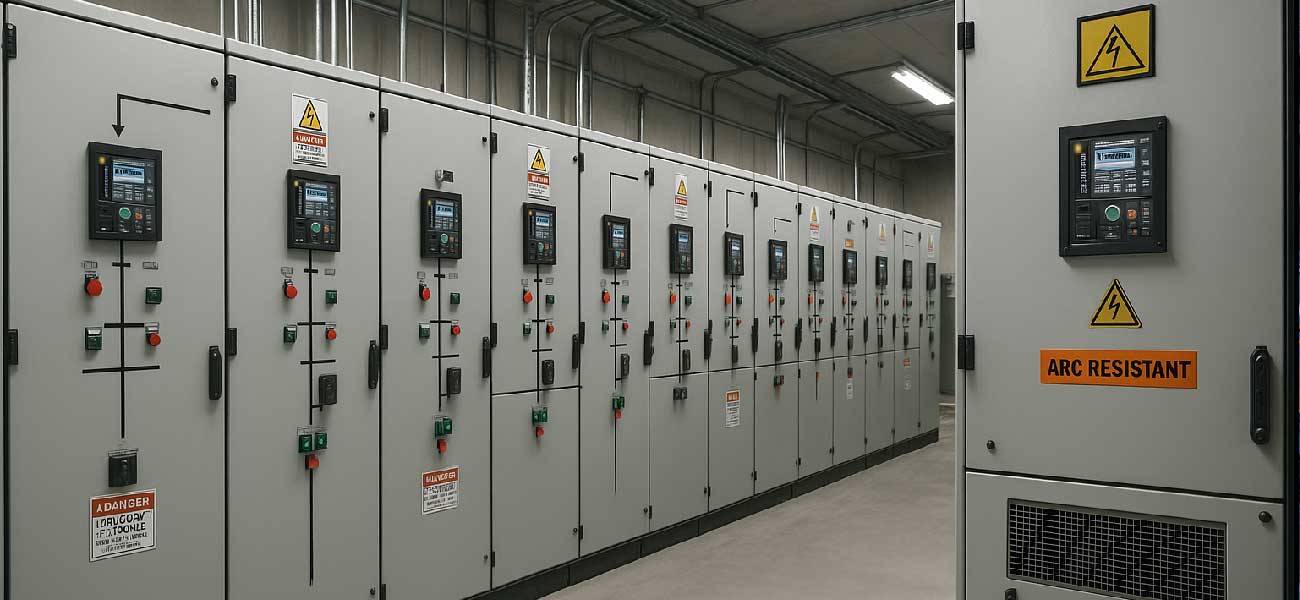
Medium‑ and low‑voltage distribution in factories and large buildings is undergoing a quiet revolution.
Arc‑resistant or arc‑mitigating switchgear paired with fast bus‑transfer logic and zone‑selective interlocking shortens clearing times and shrinks incident energy at the working face.
Modern multifunction protection relays replace a tangle of discrete devices: they handle differential, directional overcurrent, earth‑fault, and motor protection while publishing data to SCADA through IEC 61850/GOOSE and Modbus/TCP.
Incoming breakers are coordinated with downstream MCCBs/MCBs to maintain selectivity, so faults are cleared nearest the source without tripping the whole plant.
Condition‑based maintenance is becoming standard.
Thermal scanning windows, online partial‑discharge sensors for MV, and vibration/current signatures on motors feed a predictive layer that schedules outages rather than reacting to failures.
Withdrawable ACBs/MCC buckets, finger‑safe terminals, and IP‑rated cable compartments improve maintainability without compromising safety.
Where legacy rooms are space‑constrained, compact arc‑flash‑relief plenums and remote racking keep personnel outside the arc‑flash boundary during high‑risk tasks.
Power system studies—load flow, short circuit, protection coordination, and arc‑flash labeling—are now living documents kept in sync with change management.
Smart meters at feeders and critical panels provide power‑quality visibility (THD, flicker, unbalance) and reveal overloaded circuits before thermal hotspots form.
Combined with rigorous labeling, lock‑out/tag‑out (LOTO), and NFPA 70E/EN 50110 procedures, electrical rooms become auditable, safer, and easier to operate at scale.
Related Posts